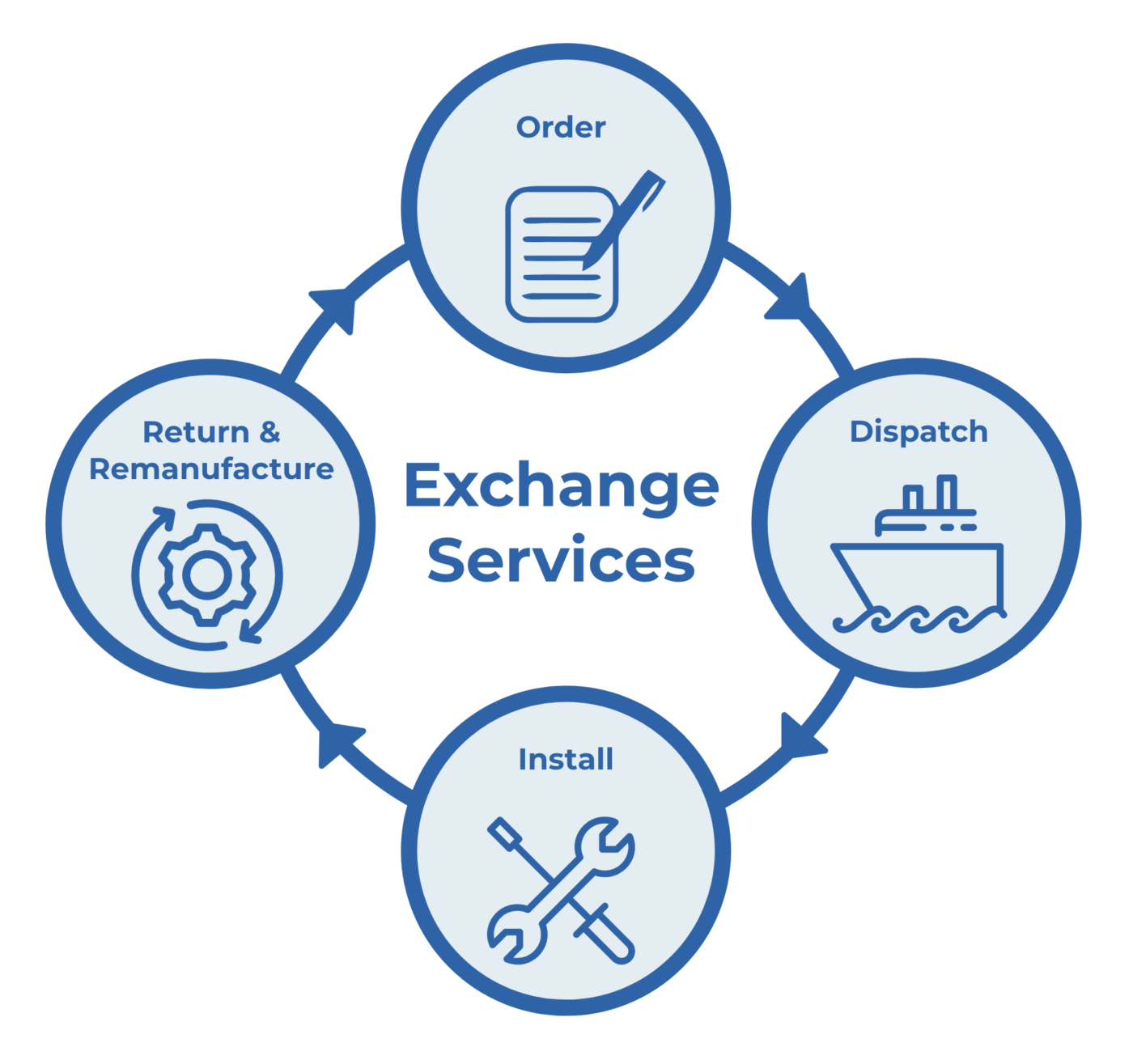
By utilizing our solutions, you actively participate in our resource-conscious approach to enhance decarbonization through circular economy principles. Our ambition is to make a significant contribution to emission reduction by remanufacturing your worn-out diesel components. Rest assured, our class-approved exchange program, certified by RINA, ensures the highest quality standards in achieving this goal.
Our remanufacturing and service solutions optimize and benefit your value chain through a circular economy approach
Our RINA-approved classification guarantees that our exchange program and repairs produce components equivalent to new ones
By utilizing the Life Cycle Assessment (LCA) we have started to develop a framework for reducing the carbon footprint of our components
By using a circular economy approach, we strive to reduce emissions in our maritime solutions
We are committed to contributing to the decarbonization of the maritime industry. We achieve this by actively investing in the development of innovative solutions that help reduce our carbon footprint. Through our certified exchange program, we enhance the efficiency and reliability of repaired engine components, thereby setting higher standards for performance and dependability.
PJ Circular Engineering has partnered with ReFlow to help transform the maritime industry by documenting the climate impact of circular engineering. By conducting climate assessments of key components, the partnership demonstrates how extending product lifecycles through remanufacturing significantly reduces carbon emissions.
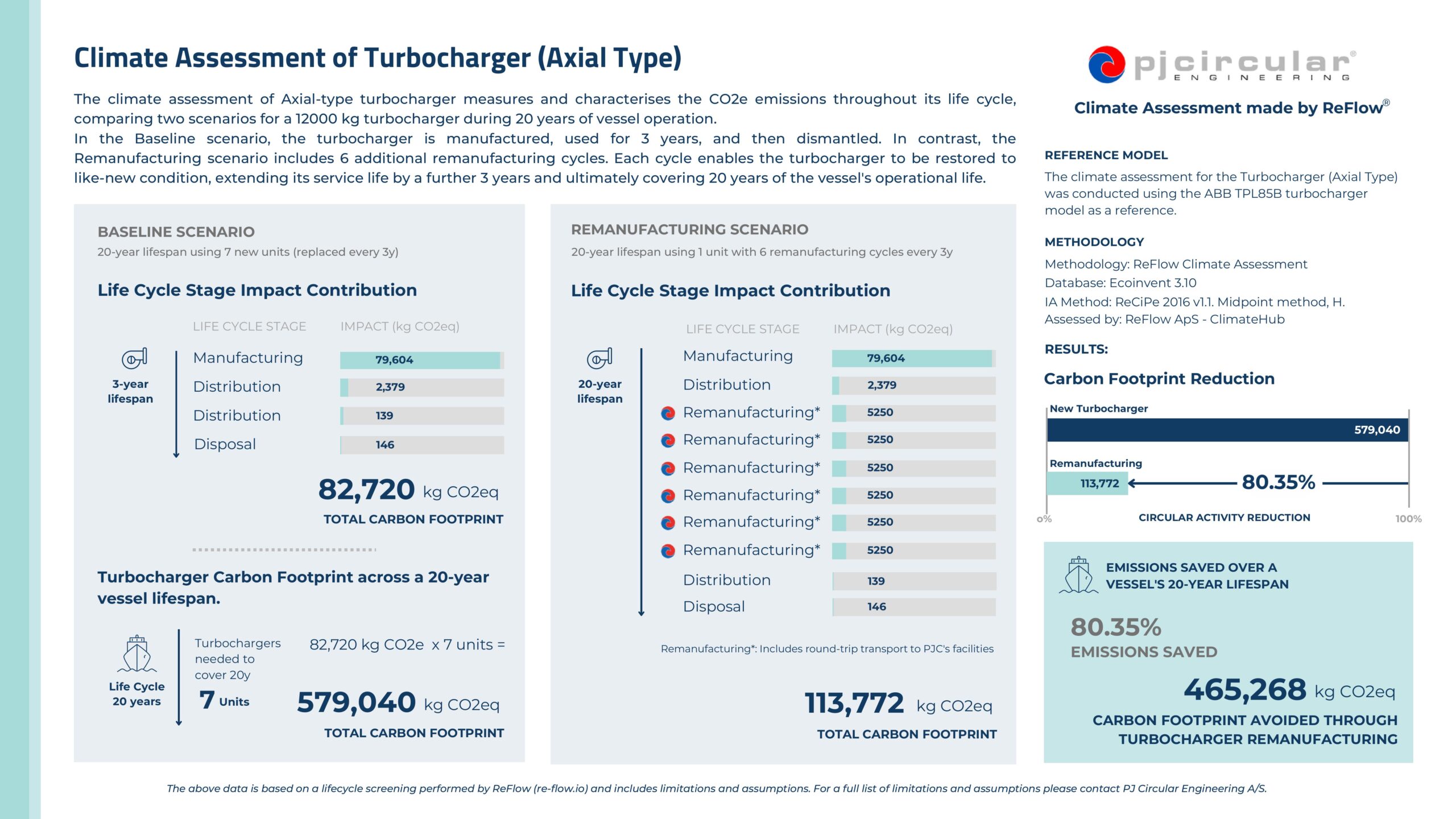
By remanufacturing an axial-type turbocharger over a 20-year vessel lifespan, PJ Circular cuts carbon emissions by over 80%, saving 465,000+ kg CO₂eq compared to using new units. A powerful step toward climate-friendly maritime operations
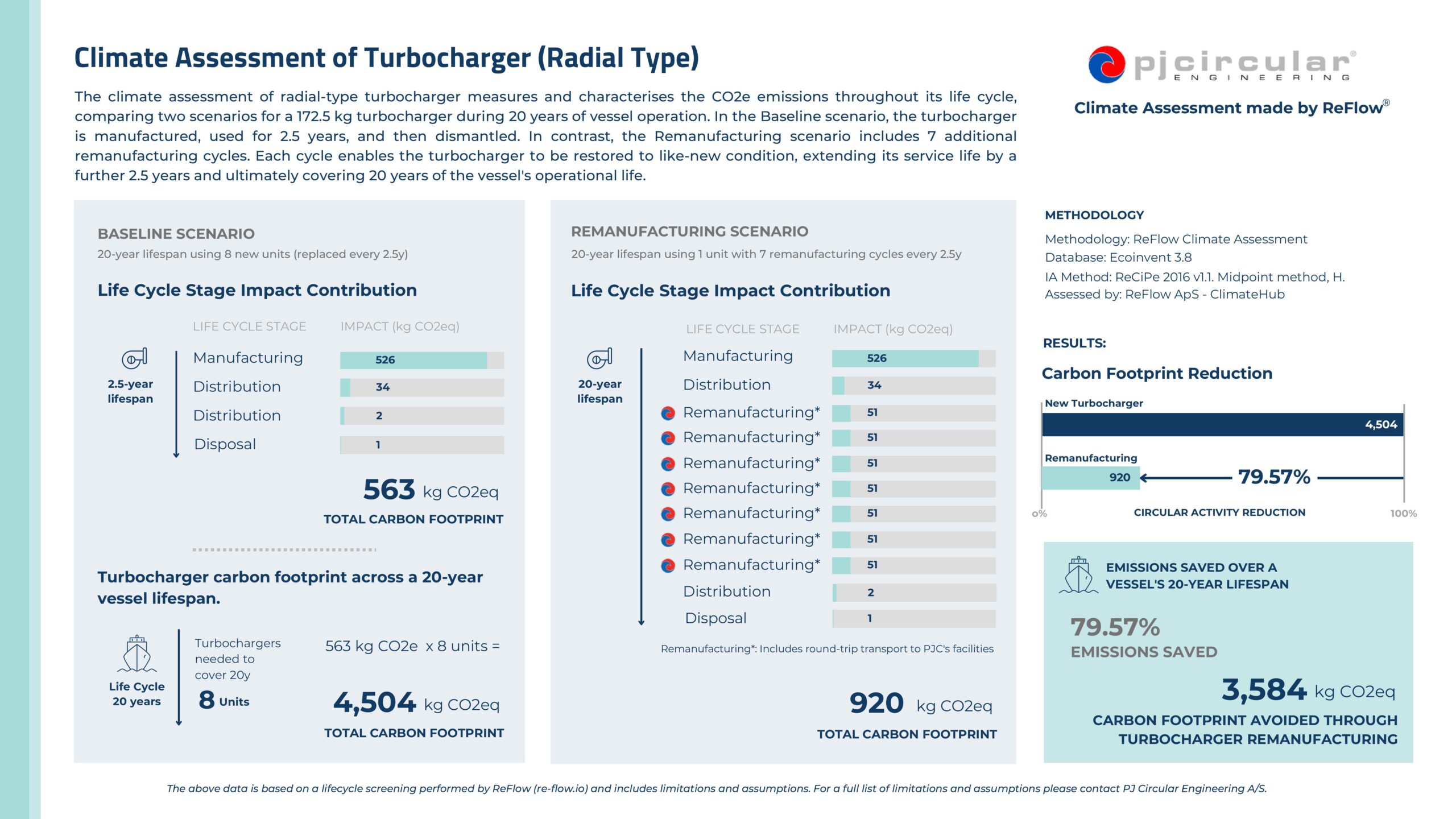
Over a 20-year vessel lifespan, remanufacturing a turbocharger (radial type) reduces emissions by nearly 80%, saving 3,584 kg CO₂eq. Circular practices extend service life while significantly cutting climate impact.
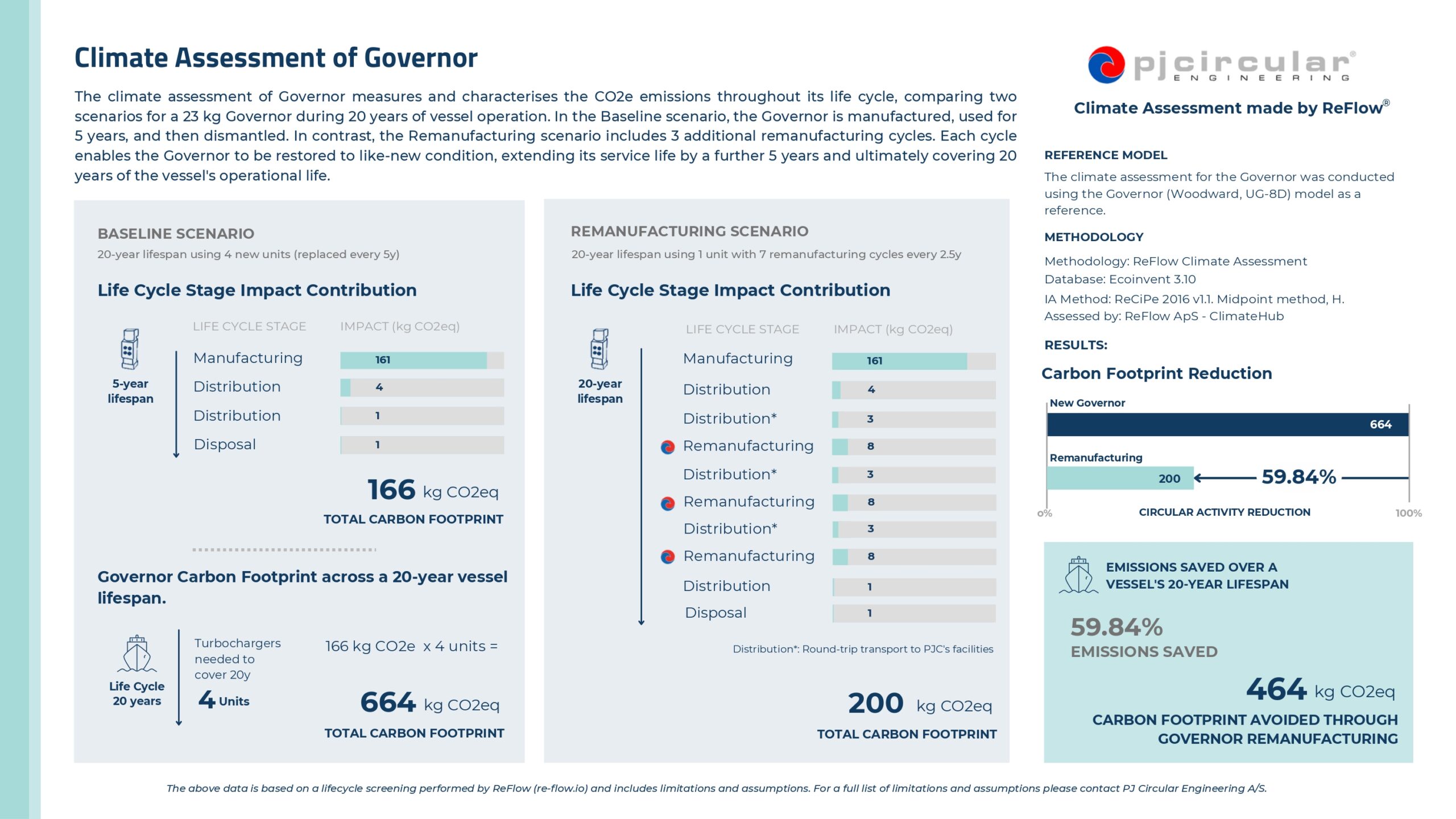
Extending the governor’s life through remanufacturing reduces emissions by nearly 60%, avoiding 464 kg CO₂eq across the vessel’s 20-year lifespan. A small component with a significant climate impact.
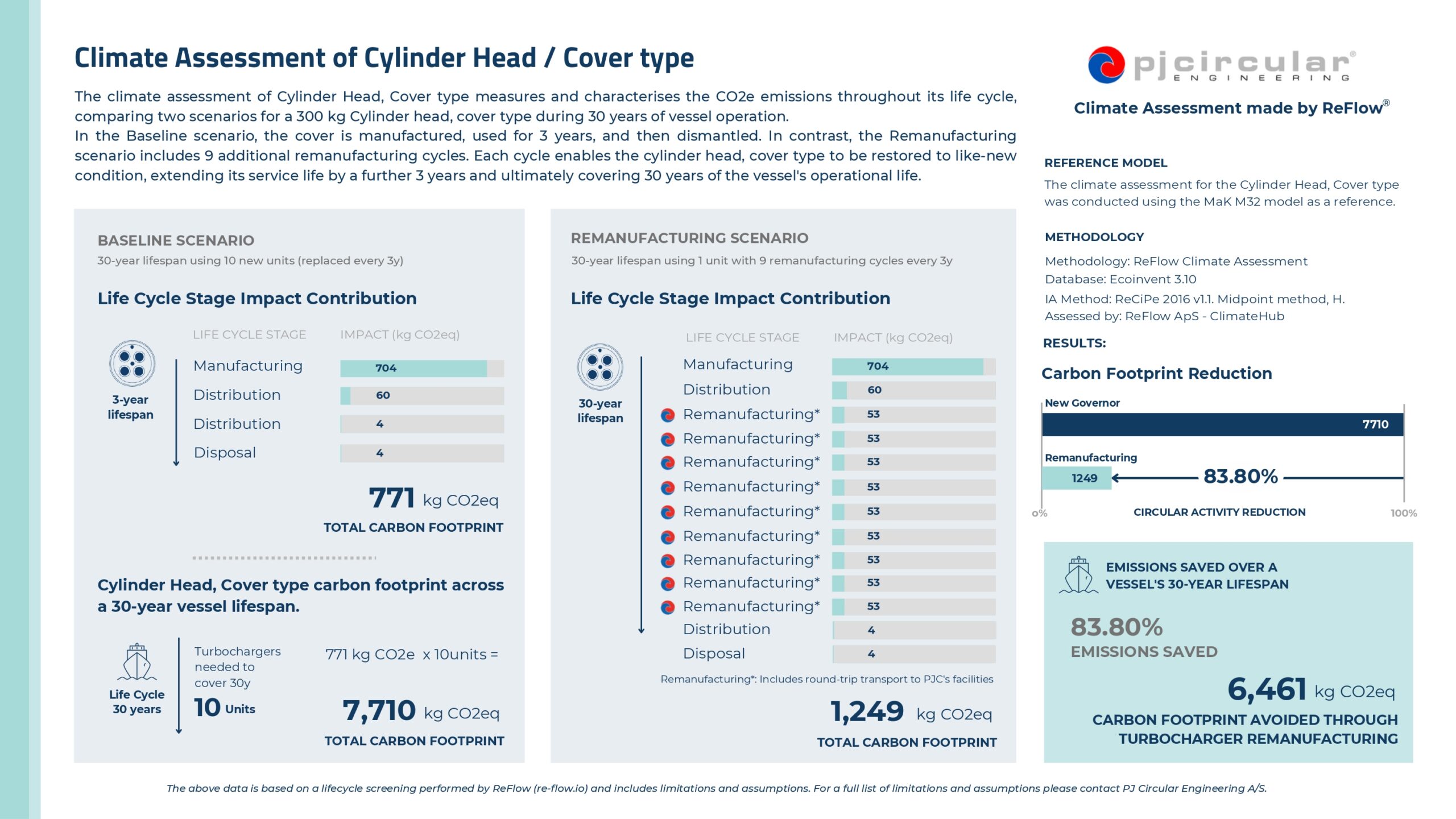
Remanufacturing a cylinder head/cover type achieves nearly 84% carbon footprint reduction over the vessel’s 30-year lifespan, avoiding 6,461 kg CO₂eq, showing the impact of circular engineering.
Our life cycle assessments, carried out with ReFlow, show reductions of about 60% to 84%, depending on the component. Over a vessel’s lifespan, this ranges from 464 kg CO2eq for a governor to more than 465,000 kg CO2eq for an axial-type turbocharger.

Four components have been assessed so far: an axial-type turbocharger (over 80% reduction), a radial-type turbocharger (nearly 80%), a governor (nearly 60%) and a cylinder head of the cover type (nearly 84%).
Each figure is based on a life cycle assessment (LCA). It compares remanufacturing the component over a 20-year vessel lifespan (30 years for the cylinder head) with using new units over the same period.
The LCA results document the carbon footprint of remanufactured components compared with new ones, and can support Scope 3 reporting for purchased goods. Contact us for the documentation for specific components.
Most of a component’s carbon footprint comes from producing new material. Remanufacturing keeps the original part in use and replaces only what is worn, so far less new material and energy is needed.
Engage in our shared response program to unlock the value of unused assets and eliminate the need for stockpiling critical components for urgent repairs
At the heart of our evolving practices lies a commitment to circularity, aimed at reducing waste and fostering the efficient utilization of resources. As active contributors to the maritime industry, we have initiated the implementation of decarbonization measurements within our solutions.
Our ability to achieve this is made possible through our value-based and innovative work culture, which emphasizes excellence in all that we do. Furthermore, our strong partnerships and collaborations play a crucial role in driving our success.